Frequently Asked Questions
What factors affect the cost of gas line work in Liberty Hill?
Five things drive the scope of a gas line job in Liberty Hill: the type of work, the material involved, access, the ground, and project-specific requirements. A straightforward indoor repair at an accessible CSST fitting is a different job from trenching a new line through caliche and limestone. Material matters too — CSST, black iron, and polyethylene each have different handling and fitting requirements. Access is a real factor in slab-foundation homes, where runs often go through attics, and in backyards where trenching has to navigate pools, patios, and mature landscaping. Propane conversions add regulator work and appliance adjustments. We evaluate every job in person and give you a written estimate before starting, with no obligation.
My Liberty Hill home is only a few years old. Why would the gas lines need attention?
Because age is not the only thing that stresses a gas system. In Liberty Hill, the two most common culprits are builder-grade installation quality and the ground itself. Production-built homes sometimes leave the builder with fittings that were never torqued to specification, CSST routed without proper protection, or bonding that was skipped — defects that surface years after move-in. Meanwhile, the caliche and limestone under your lot make every underground repair a rock job, and any buried line installed without proper rock clearance can be pinched or abraded from the start. If your home is still inside its builder warranty period, the builder may be responsible for correcting defective work — check your warranty documents first. Either way, a pressure test and inspection will show exactly what your system needs.
Can you run a gas line for my pool heater or outdoor kitchen?
Yes — this is some of our most common work in Liberty Hill. A pool heater needs a large dedicated gas line, often larger than the homeowner expects, because its demand can exceed the furnace, water heater, and range combined. We calculate the heater’s demand, verify your meter’s capacity against the new total load, and run a properly sized line to the equipment pad — trenched through caliche and limestone with proper bedding, protection, and tracer wire. We do the same for outdoor kitchens, fire pits, and patio heaters: load calculation first, then correctly sized underground piping and full pressure testing.
How do I know if my gas line is leaking?
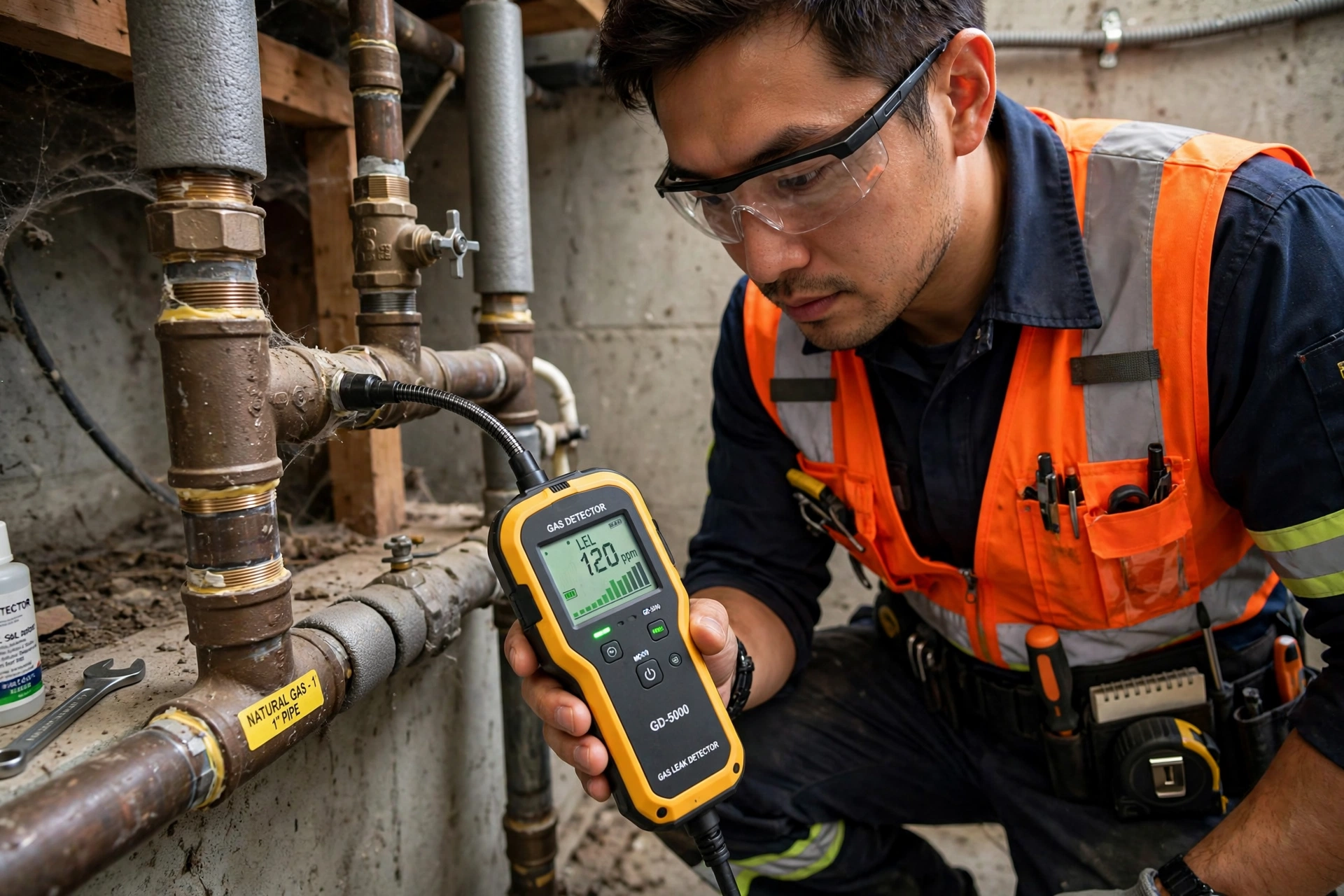
The main signs are a rotten-egg gas smell near appliances, the manifold, or outdoors; hissing sounds at fittings or the meter; dead vegetation in a strip along the underground line route; and gas bills that increase without more usage. On propane properties, a tank that empties far faster than normal is the equivalent warning sign. Because so much of Liberty Hill’s housing is newer, a leak is usually a single failed fitting or a damaged buried section rather than a system-wide problem — which also means it is usually very fixable once located. If you notice any of these signs, have the system checked. Gas leaks do not fix themselves.
We live on the outskirts and still have a propane tank. Can you convert us to natural gas?
In most cases, yes. First we confirm that natural gas service is available at your property — coverage along the SH-29 corridor has been expanding with the growth. Then the work is: removing the propane regulator setup, trenching a new service run from the meter to the house (through caliche and rock where necessary), adjusting or converting appliances for natural gas pressure and orifice sizing, and pressure-testing the reconfigured system end to end. Conversions require permits and inspection, and we make sure the work is ready to pass. If natural gas is not available at your lot yet, we can instead service and upgrade your propane system — regulators, pigtails, and tank-area lines — so it runs safely in the meantime.
Does Liberty Hill’s rocky soil really affect gas lines?
Yes — it is the defining physical fact of underground gas work here. Caliche and limestone sit just under the topsoil across this corridor, and lines buried without proper rock clearance get pinched, abraded, or laid too shallow to be safe. Shallow lines are vulnerable to digging, landscaping, and traffic loads. Modern polyethylene pipe handles ground movement well, but only when it is bedded and protected correctly in a properly cut trench. That is why we plan every underground job around the rock: proper trench depth, bedding, protection, and tracer wire so the route can be found again without guesswork.