Gas Line Repair Leander TX
Get Estimate

Gas Line Replacement in Leander, TX

When patching an old gas line stops making sense, a full or partial replacement gives your Leander home a fresh start. We swap out corroded steel and undersized pipe for modern materials, pull the permits, and pressure-test everything before your gas goes back on.


Across Leander — from older homes near Old Town to newer builds in Bridlewood and Crystal Falls — aging steel gas lines corrode, joints loosen, and repairs turn into a recurring expense. Our replacement service removes the failing pipe entirely and installs a system sized for the appliances you have today, with room for the ones you might add later.

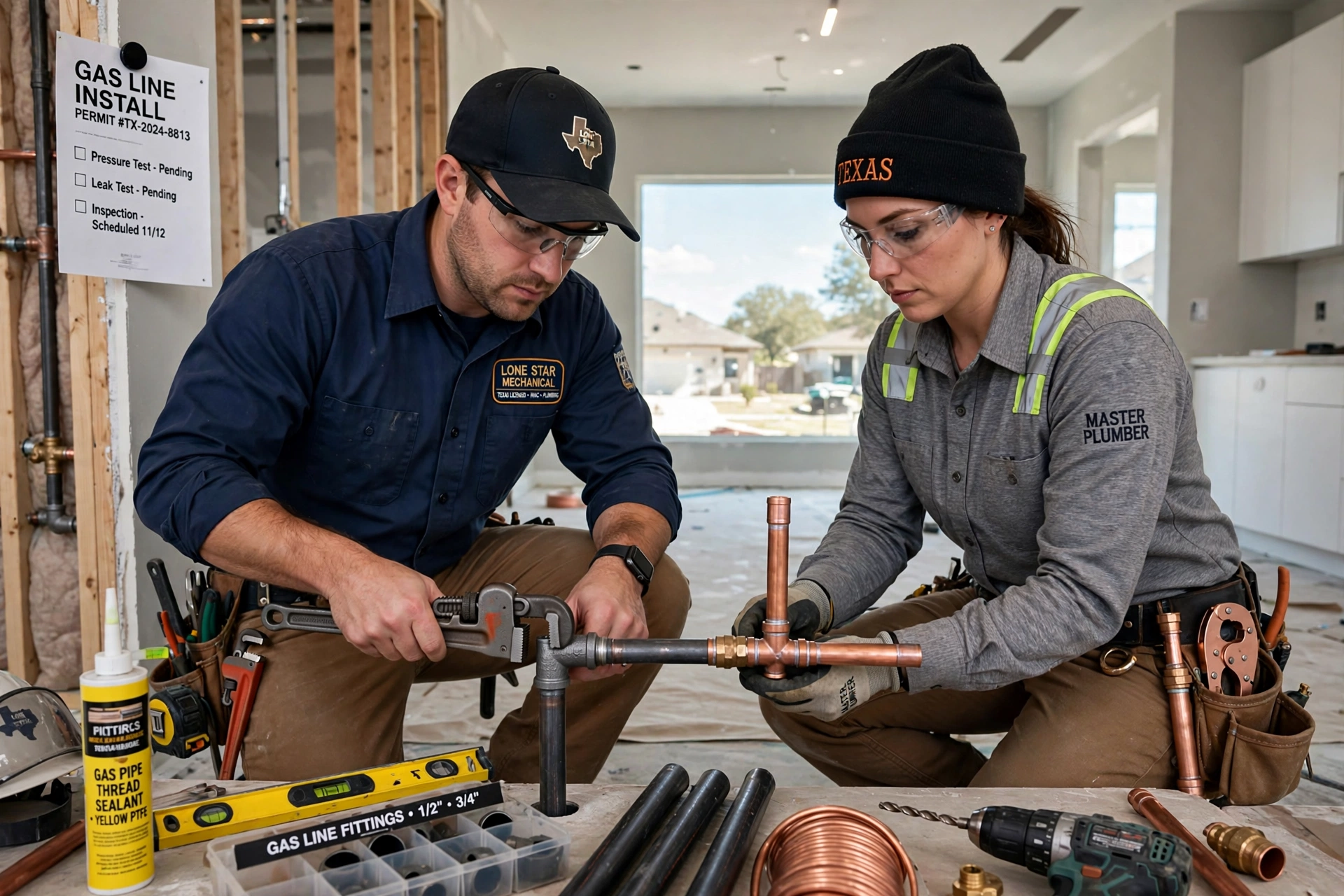
Gas fitter applying pipe thread sealant to a steel gas fitting during a gas line replacement in Leander, TX
Experienced Experienced Team
Fully Insured Insured & Bonded
24/7 Emergency Ready When You Call
Quality Focused Serving Leander Homes & Businesses

When Gas Line Replacement Makes More Sense Than Repair

A repair fixes one problem. A replacement ends the cycle of problems. Here is how we help you decide which one your home actually needs.

Honest Assessment First

We start with a full inspection of your gas system — every visible run of pipe, every joint, the meter riser, and the underground section where it can be examined. You get a straight explanation of what is failing, what is sound, and whether another repair would be money well spent or just a postponement.

Corroded Steel, Retired for Good

Much of Leander's older housing stock still runs on its original black iron or galvanized steel pipe. Where corrosion has taken hold in multiple spots, replacing the run with modern materials ends the leak-repair-leak cycle instead of feeding it.

Permits and Code, Handled

Gas re-piping in Leander requires a permit and a passed inspection before the utility restores service. We prepare the application, schedule the inspection, and make sure the finished work meets current code — not the code from the year your house was built.

Pressure-Tested Proof

Every replacement ends with an air pressure test that proves the new system is leak-free, plus a walkthrough where we show you the shutoff locations and what was replaced. You get documentation for your records, not just a handshake.

Gas Pipe Materials: Black Iron, CSST, and Polyethylene

The right pipe depends on where it runs, and a full replacement often uses two or even three materials in a single project. Inside the house, the choice comes down to black iron or corrugated stainless steel tubing (CSST). Underground, polyethylene (PE) pipe is the modern standard. Each material earns its place: what works in a dry attic is the wrong choice in Hill Country soil, and vice versa. Understanding the options helps you see why your technician recommends a particular mix for your home.

Black iron has carried indoor gas for generations, and it is still a solid choice for straight, accessible runs — along an unfinished garage ceiling, through a utility room, or anywhere the pipe stays dry and visible. Its threaded joints are familiar to every gas technician, and the rigid pipe holds its line neatly where it needs to support valves and sediment traps. Its weakness is moisture: in damp crawl spaces or where condensation collects, steel corrodes from the outside in. That is exactly why older Leander homes with aging steel runs are prime candidates for replacement — the pipe did its job for decades, but its service life in the wrong conditions is finite.

CSST is flexible stainless steel tubing that snakes through walls, attics, and crawl spaces with far fewer joints than rigid pipe — and every joint you eliminate is a potential leak point you never have to worry about. For re-piping a finished home, that flexibility is the whole game: instead of opening long stretches of drywall, the tubing threads through existing cavities and around obstacles. It does require proper bonding to the home's electrical grounding system, and that bonding is part of every professional CSST installation, inspected along with the rest of the work. Where routing is tight and demolition should stay minimal, CSST usually wins.

Underground, the answer is polyethylene. PE pipe does not corrode in soil, it flexes when expansive clay shifts instead of cracking, and it is joined by heat fusion that creates one continuous run with no buried joints to fail. That combination is why it has become the standard for buried residential gas lines across Central Texas. The riser — the assembly where the pipe comes out of the ground at the meter and at the house — gets special attention with corrosion-resistant fittings and protective sleeves, since that transition zone is where buried lines have historically failed first.

Full vs. Partial Gas Line Replacement

A replacement project should match the condition of your system, not a one-size-fits-all template. In practice that means one of two scopes. A full replacement — a re-pipe — takes the entire gas system back to like-new condition, from the meter through every branch and appliance connection. A partial replacement targets only the failing sections and leaves pipe that is still sound in place. An honest assessment, one that actually inspects the whole system rather than glancing at the obvious problem, is what tells you which scope fits.

Full re-piping is the right call when the original pipe is uniformly aged, when corrosion or failing joints show up in more than one area, or when you simply want the decades-long certainty of starting over. Every run of old pipe comes out, every joint is new, and the whole system is sized for your current appliances and tested to today's standards. It is the bigger project — more pipe, more labor, more of the house involved — but it resets the clock completely. For homes with original steel piping from decades ago, especially in Leander's older neighborhoods, this is often the most economical choice over a ten-year horizon: one project instead of a repair bill every year or two.

Partial replacement makes sense when the assessment shows the rest of the system is genuinely sound. The most common partial jobs we see are the underground run from the meter to the house — where soil and moisture have done their worst — a corroded riser assembly, or a single interior branch that has deteriorated while the rest tests fine. The key word is tests: the remaining pipe must be evaluated and pressure tested along with the new work, not just assumed to be fine because it looks okay. If the evaluation raises doubts about other sections, a straight answer beats leaving questionable pipe in the walls.

A full re-pipe is a planned project, not an emergency scramble. It typically begins with the gas shut off at the meter and the existing system mapped — every branch, valve, and appliance connection documented so the new layout serves everything the old one did. Permits are pulled with the City of Leander, and the work is scheduled so the inspection can follow promptly after installation. Most residential re-pipes take a matter of days rather than weeks, and your technician should walk you through the day-by-day schedule before the first wrench turns.

What the Replacement Process Looks Like

Knowing the sequence takes the mystery out of a replacement project. While every house is different — a single-story ranch in Bridlewood routes differently than a two-story in Travisso — the steps are consistent: assessment and planning, permits, installation, pressure testing, inspection, and restoration. Most residential replacements finish in days, and a good technician explains the timeline in plain terms before work begins so you can plan around the gas outage.

The project starts with mapping. The technician documents every gas appliance and fixture — furnace, water heaters, range or cooktop, dryer, fireplaces, outdoor kitchen, pool heater, standby generator — and traces how the existing piping serves them. This map becomes the plan for the new system, including pipe sizing. Sizing matters because every appliance draws a specific volume of gas, and the pipe must deliver it all at once without pressure drop. If you are thinking about adding a gas appliance down the road — a tankless water heater, an outdoor grill stub, a fire pit — say so now. Upsizing a run during replacement costs far less than opening walls again later.

Permits come next. Gas piping work in Leander requires a permit from the city's building inspections office, and the finished installation must pass inspection before Atmos Energy restores service at the meter. We handle the permit application as part of the project and coordinate the inspection when the work is complete. During installation the gas stays off, so the furnace, water heater, and stove will be out of service for the duration — many homeowners schedule the work during mild spring or fall weather and plan meals accordingly. Your technician will give you a realistic timeline before the project starts.

Good preparation prevents delays. Before installation day, the technician confirms the full appliance list, verifies access to attics, crawl spaces, garages, and utility areas, and identifies exactly where the new pipe will run. For underground sections, the route is planned around other utilities: Texas 811 marks the public lines for free, and the technician accounts for private lines — sprinkler systems, landscape lighting, invisible fence wire — based on what you tell them and what is visible in the yard. On installation day, the crew protects floors and landscaping along the work path, and the job is not done until the site is cleaned up.

After Replacement: Inspection, Restoration, and Long-Term Care

01

Pressure testing and inspection

What we do: The new system is filled with air and held at test pressure to prove every joint is leak-free, then the city inspector verifies the installation meets code.

→ You get documented proof — test results and the passed inspection record — that your system is sound.

02

Gas restored and appliances relit

What we do: Once the work passes inspection, Atmos Energy restores service at the meter. We then relight every pilot, check each appliance under load, and confirm proper operation throughout the house.

→ Your furnace, water heater, range, and other gas appliances are verified working before we leave.

03

Restoration and long-term care

What we do: Openings made for routing are patched, trenches are backfilled and graded, and we walk you through the new system — shutoff locations, what was replaced, and what to watch for over the years.

→ Your home is left clean and documented, and you know exactly how to care for the new piping.

Gas Line Replacement in Leander: Local Knowledge

Replacing gas pipe in Leander is not the same job as replacing it anywhere else. The Hill Country edge brings limestone, expansive clay that swells and shrinks with the seasons, and soil movement that stresses buried lines. Add in fast-growing master-planned communities alongside older homes with original steel piping, and the local picture matters. We plan every replacement around the conditions your house actually faces.

Neighborhoods We Serve

  • Bridlewood

    Many homes here date to earlier phases of Leander's growth, and original steel gas lines are reaching the age where corrosion and joint failures become routine.

  • Crystal Falls

    A large master-planned community where replacement work usually means upsizing for added outdoor kitchens, pool heaters, and fire features rather than fixing age.

  • Travisso

    On Leander's western Hill Country edge, where limestone and sloped lots make underground routing a planning exercise that rewards experience.

Local Conditions We Plan For

  • Expansive clay soil

    The clay under much of Leander swells when wet and shrinks when dry, shifting several inches between seasons. That movement stresses buried gas lines and their risers, which is why we use flexible polyethylene underground and give transition fittings extra protection.

  • Hard freezes and hot summers

    Central Texas weather swings from triple-digit summers to hard freezes like February 2021. Freeze-thaw cycles and soil movement work joints loose over time, and older steel pipe with decades of corrosion is the first to show it.

Replacement Projects We Handle Most Often

Before

A homeowner's steel gas line had been repaired three times in two years — a joint here, a pinhole leak there.

After

We replaced the full interior run with CSST, pressure tested the system, and the cycle of repeat repairs ended.

Maintenance: One full replacement instead of yearly patch repairs — and the new system is documented for the home's records.

Before

Corrosion on the underground run from the meter kept producing leaks near the riser.

After

We replaced the buried section with fused polyethylene pipe and rebuilt the riser with corrosion-resistant fittings.

Maintenance: Buried PE pipe does not corrode, and the new tracer wire means the line can be located any time in the future.

Before

A growing family was adding a tankless water heater and an outdoor kitchen, but the existing pipe was undersized.

After

During the re-pipe we upsized the main runs and added stub-outs for the new appliances, all in a single project.

Maintenance: Planning gas capacity during replacement is far cheaper than opening walls again for each new appliance.

Problems Solved by Gas Line Replacement

Replacement is the answer when the piping itself has become the problem — not a fitting, not a single joint, but the system.

Problem

Recurring leaks in aging steel pipe

When leaks keep appearing in different spots, the pipe is telling you its service life is over. Each repair fixes one failure while the rest of the run keeps deteriorating.

Our Fix

We remove the failing pipe entirely and install modern materials — no more chasing the next pinhole leak.

Problem

Undersized pipe starving your appliances

A furnace that struggles when the water heater fires, or a range whose burners weaken under load, often points to pipe that was sized for a smaller appliance lineup.

Our Fix

Replacement lets us size every run for your actual BTU load, so all appliances get full gas flow even running together.

Problem

Corroded risers and buried sections

The underground run from the meter lives in the harshest environment on your property — moisture, soil movement, and decades of exposure. Risers where pipe exits the ground corrode first.

Our Fix

We replace buried sections with fused polyethylene that cannot corrode and rebuild risers with protected, corrosion-resistant assemblies.

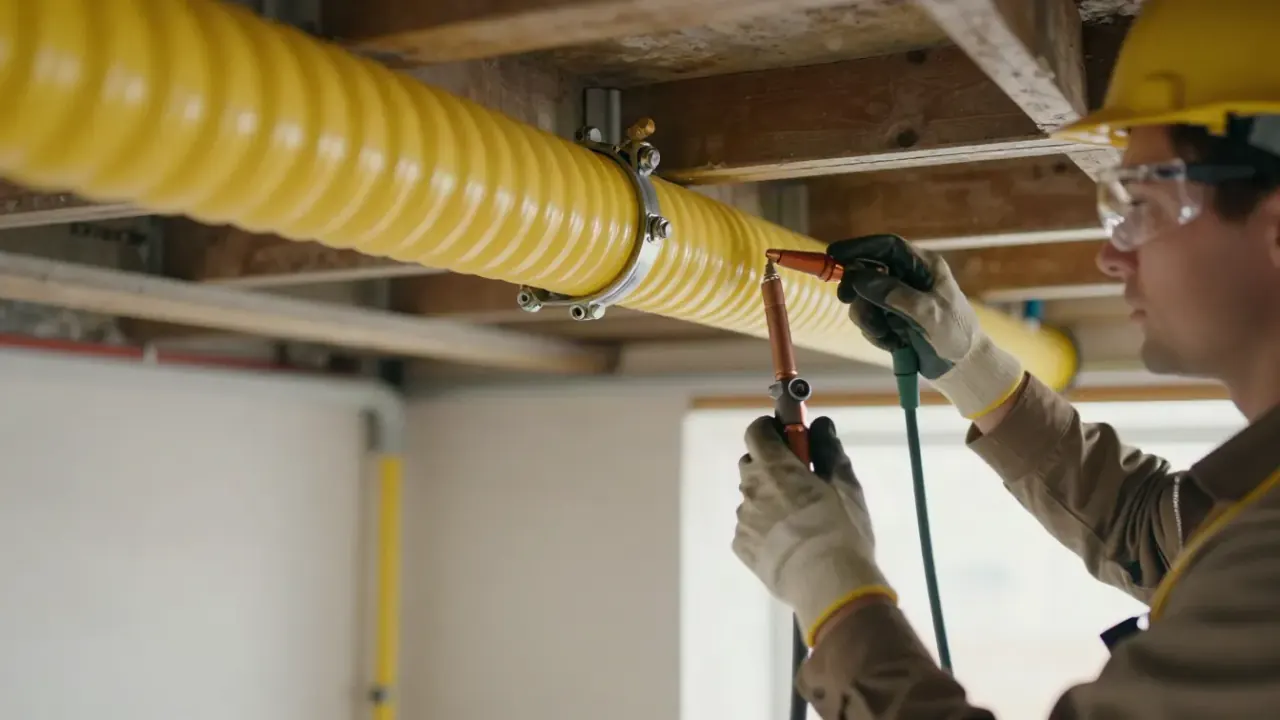
Newly installed yellow CSST gas line run inside a Leander, TX home during a whole-house gas line replacement

Benefits of Gas Line Replacement

A new gas piping system changes the equation from managing decline to starting fresh.

  • Decades of Service Ahead

    Modern pipe materials — CSST indoors, polyethylene underground — are engineered for long service lives. A full replacement resets the clock instead of extending a deteriorating system one repair at a time.

  • Fewer Surprises, Lower Long-Term Cost

    Three repair visits in two years often cost more than the replacement that would have ended them. One planned project replaces the drip of emergency calls, repeat diagnostics, and patchwork fixes.

  • Capacity for What Comes Next

    Replacement is the natural moment to size for the future: a tankless water heater, a gas dryer, an outdoor kitchen, or a standby generator. Adding capacity during a re-pipe is straightforward; adding it later means starting over.

  • Code-Current and Documented

    A permitted replacement brings your gas system up to current code — proper bonding, correct sizing, accessible shutoffs — and leaves you with inspection records and test documentation that protect you at resale time.

Gas Line Replacement Cost Factors in Leander

Every replacement is quoted on its own merits, because no two houses route the same way. A single-story home with an accessible attic is a different project than a two-story with slab construction and a long buried run. What we can tell you plainly are the factors that move the number — so when you receive a quote, you understand exactly what is behind it.

Typical Investment Range

Every project priced in writing

You receive an itemized written quote before any work begins — no surprises, no vague allowances.

What changes the price

01

Scope: Full vs. Partial

A whole-house re-pipe involves far more pipe, fittings, and labor than replacing a single buried run or riser — scope is the biggest cost driver.

02

Materials and Routing

CSST, black iron, and polyethylene each carry different material and labor profiles, and difficult routing through finished spaces adds time.

03

Access and Restoration

Tight attics, slab foundations, long trench runs, and the patching and grading afterward all factor into the final number.

Why Leander Homeowners Trust Our Gas Line Work

What We Bring to the Job

  • Focused gas line experience — replacement and re-piping is core work for us, not an occasional side job
  • Code-current installations — every project is permitted, inspected, and built to current fuel gas code
  • Proper test equipment — calibrated pressure gauges and professional-grade tools on every job

How We Treat Your Home

Clear communication

We explain what we found, what your options are, and what the work will involve — before anything is disconnected.

Respect for your property

Drop cloths, careful routing, patched openings, graded trenches, and a full cleanup are part of every project.

Tested and documented

Pressure tests, passed inspections, and paperwork for your records — proof the job was done right.

Our Experience With Gas Line Replacement

Replacement is a planning discipline as much as a trade skill. Our work centers on gas piping — assessing aging systems, designing the new layout, and executing re-pipes cleanly in occupied homes.

  • Whole-house re-pipes in occupied homes, planned around your schedule and the gas outage.
  • CSST, black iron, and polyethylene installations — each material used where it performs best.
  • Working knowledge of the National Fuel Gas Code and City of Leander inspection requirements.
  • Underground routing with Texas 811 locates, tracer wire, and proper burial depth on every run.
Get Started Today
Gas fitter tightening a fitting with a pipe wrench during a gas line replacement project in Leander, TX

How We Handle Every Replacement Project

Three standards guide our work on every gas line replacement in Leander.

Safety is the entire job. Every replacement is pressure tested with air, inspected by the city, and verified appliance by appliance before we consider it finished.

T

Tested & Inspected

Every project, every time

A clean job site is part of the quote, not a favor. We protect floors and landscaping, patch what we open, grade what we dig, and leave your home as we found it.

C

Clean Job Sites

Respect for your home

You will always know what we found, what it costs, and what happens next. Written scope, clear schedule, and a walkthrough of the finished system — no surprises.

H

Honest Communication

No surprises, ever

Frequently Asked Questions

How do I know if my gas line needs replacement instead of just a repair?

Replacement is usually the right call when leaks keep recurring in different spots, when corrosion or damage shows up in multiple areas, or when the piping is decades old and an inspection finds it deteriorating throughout. A single failed fitting on an otherwise sound system is a repair job. After a full assessment, we will show you exactly which sections are failing and give you a straight recommendation — repair or replace — with the reasoning behind it.

What pipe materials do you use for gas line replacement in Leander?

Indoors we use black iron for straight accessible runs and CSST — flexible stainless steel tubing — where routing through finished walls and attics needs to stay minimally invasive. Underground we use polyethylene pipe, which cannot corrode and flexes with Leander's expansive clay soil instead of cracking. Each material is used where it performs most reliably, and every installation is bonded, supported, and installed to current code.

Will I need a permit for gas line replacement in Leander?

Yes — gas piping work in Leander requires a permit from the city's building inspections office, and the finished installation must pass inspection before Atmos Energy restores service. We handle the permit application as part of the project and coordinate the inspection when the work is complete, so you do not have to navigate the process yourself.

How long will my gas be shut off during a replacement?

The gas stays off for the installation and testing portion of the project, which for most homes is a matter of days. Your furnace, water heater, and gas stove will be out of service during that window. Before work begins, your technician will lay out a realistic day-by-day schedule so you can plan around it — many homeowners schedule replacements during mild spring or fall weather to minimize disruption.

Can you replace just part of my gas line, or does it have to be the whole system?

Partial replacement is absolutely an option when the assessment shows the rest of the system is sound. Common partial jobs in Leander include the underground run from the meter to the house, a corroded riser assembly, or one deteriorated interior branch. The remaining pipe is evaluated and pressure tested along with the new work — if the evaluation raises doubts about other sections, we will tell you plainly rather than leave questionable pipe in service.

Will replacement work damage my walls or yard?

Some disruption is unavoidable, but it is planned and minimized. Interior re-piping may require small openings in walls or ceilings to route pipe, and CSST's flexibility keeps that demolition to a minimum — the openings are patched as part of the job. Underground replacement involves trenching along the pipe route, and the trench is backfilled, graded, and cleaned up afterward. You will know the full plan before work starts.

What happens after the new gas line is installed?

The system is pressure tested with air to prove it is leak-free, then the city inspects the work. Once it passes, Atmos Energy restores service at the meter. Our technician then relights pilots, verifies each appliance operates correctly under load, and walks you through the new system — shutoff locations, what was replaced, and what to watch for. You receive documentation of the work, including the permit record and test results, for your home records.
Get Reliable Gas Line Replacement in Leander Today

If repairs have become a routine expense, it may be time to start fresh. Contact us for an honest assessment of your gas system and a clear written quote for replacement.

Call Now Request Service

Get in Touch with Us

Tell us about your gas line project — replacement, inspection, or a second opinion on aging pipe. Reach out during business hours and we will respond promptly.

Or call us right now at (512) 877-2533 — we answer.

Gas Line Repair Leander TX


  • Address

    1789 S Bagdad Rd, Leander, TX 78641, USA, Leander, Texas

  • Hours

    Mon–Fri: 7AM – 7PM
    Sat: 8AM – 4PM
    Sun: Emergency Only
    24/7 Emergency Available

Call (512) 877-2533 Get Quote
Call Quote